Fancy sapphires, those outside the canonical blue, occupy a narrower stratum of the gem trade. Colour dominates their valuation to a degree that distinguishes them from even their blue relatives; a fraction of a degree on the colour wheel can double or halve a stone’s significance. This is the context in which The Sapphire Parure should be understood.
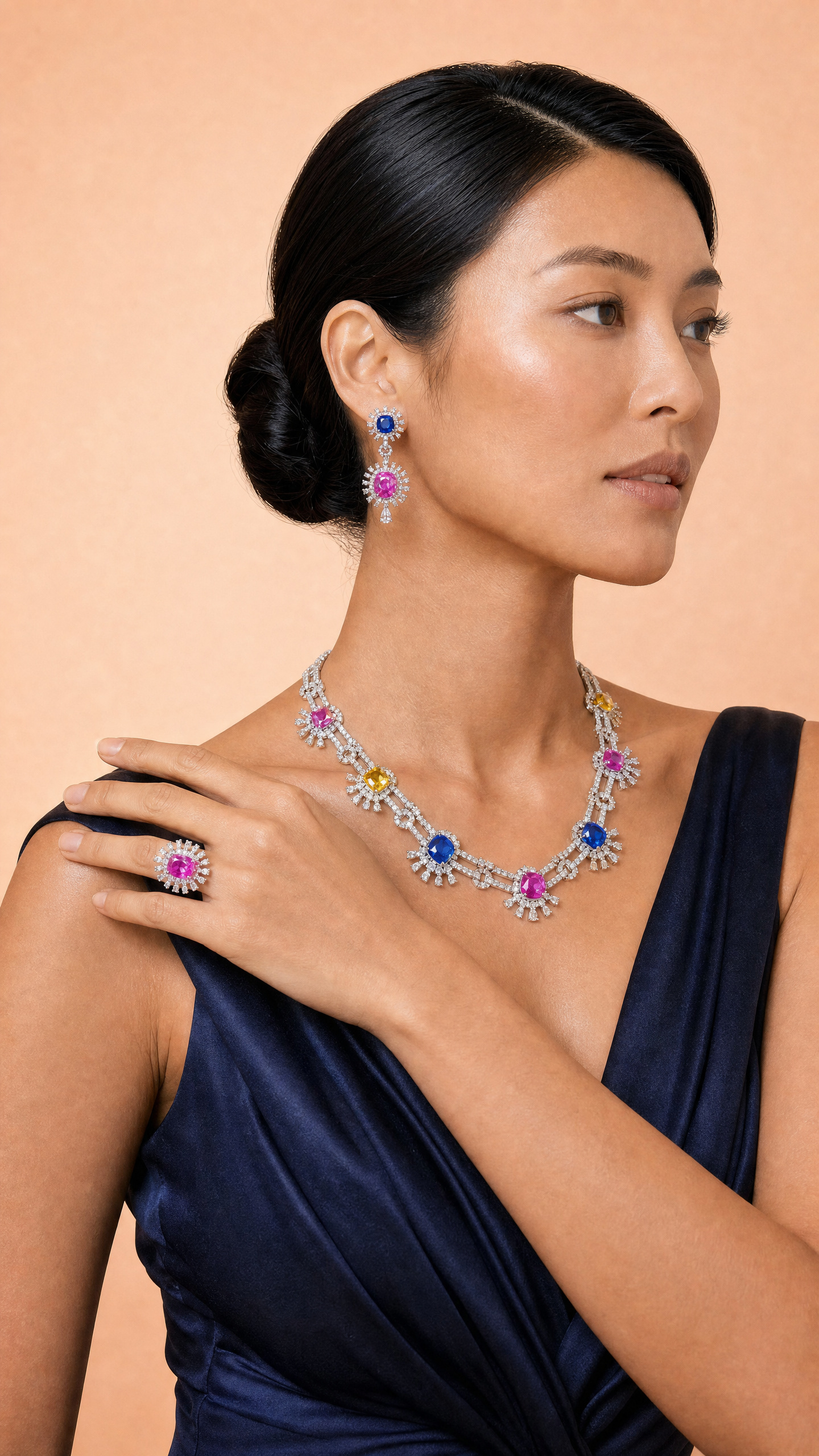
The set comprises four pieces, bracelet, earrings, necklace and ring, each centred on a matched fancy sapphire in a colour the house describes as lying between violet and twilight. For a single stone in this colour to be exceptional is unusual. For four to share it closely enough to be set as a parure is, as the house notes, the work of years, not seasons.
01 · Colour
The first and most important C.
The colour of a fancy sapphire is assessed across three dimensions: hue, tone and saturation. Hue places the stone on the colour wheel; tone measures its lightness or darkness; saturation measures the intensity of the colour itself. For fancy sapphires, this triad determines value far more than carat weight or cut grade.
The sapphires in the Parure sit at the boundary of violetish-blue and bluish-violet in the GRS classification system, a region where two hue families meet and which the trade historically undervalued because it did not fit neatly into either. They carry a medium-to-dark tone: present but not overwhelmed by their own depth. Their saturation is described by the 2008 GRS certificate as vivid, the highest category in the GRS grading matrix.
The matching challenge is not merely visual. Stones with this combination of hue, tone and saturation come from a limited range of deposits. The Parure draws from a single provenance confirmed across all four stones, which itself constrains the pool from which a match could ever be assembled.
On the stone’s colour
“The colour lies between violet and twilight: rare in a single stone, and nearly impossible to match across four.”
02 · Clarity
What inclusions tell us about origin.
Sapphires are classified as Type II gemstones, a category that accepts inclusions as natural and expected features of the crystal. For Type II stones, the commercial standard is eye-clean: no inclusions visible to the unaided eye at normal viewing distance. All four sapphires in the Parure meet this standard.
Beyond the commercial threshold, inclusions in Type II corundum carry information. Certain silk patterns, fingerprint inclusions and mineral crystal types are characteristic of specific geographic origins, forming part of the evidentiary basis on which laboratory origin certificates are issued. The lapidary and the laboratory read the same crystal for different reasons.
The 2008 GRS certificate drew on this micro-evidence to confirm geographic origin. Sixteen years later, the 2023 ICA evaluation reviewed the same inclusions and reached the same conclusion. For a stone to receive an identical origin determination from an independent laboratory after fifteen years is, in gemmological terms, a strong statement of material consistency.
03 · Cut
Built for lateral light return.
The standard cut for fancy sapphires of this size and quality is the oval or cushion modified brilliant, a form that preserves weight from the rough while maximising light return from the colour of the stone. For colour stones, brilliance is not the primary target; vivid, even colour with minimal zoning visible face-up is. The lapidary works at the intersection of optics and aesthetics.
The settings for the Parure were built individually around each stone before the pavé diamond work was begun: stone first, metalwork second. The platinum collets were designed to allow lateral light to enter through the girdle, reinforcing the colour rather than confining it inside a tight bezel. Fourteen weeks at the bench. Three craftsmen’s signatures in the workshop dossier.
The result, particularly in the bracelet and ring where the stones sit close to the skin, is a colour that shifts across the arc of a day: cooler under noon light, and deeper, more violet than blue, under warm evening sources.
04 · Carat
Weight is not the measure.
The individual stone weights are certified in the GRS report and available on request; the house does not publish carat weights in public surfaces. What matters here is not absolute weight but the proportional relationship between the four stones. When set side by side, as in the bracelet, any significant disparity in size becomes immediately visible to the eye and disrupts the ensemble.
The stones in this Parure were selected to maintain correspondence not only in colour but in their proportional relationship within each piece. The necklace, bracelet, earrings and ring read as a single intention across four objects.
This Parure was assembled over time, not sourced from a single parcel. That is the central fact of its carat story: not that the stones are large, though they are, but that they were found, held, and matched despite arriving at different points across several decades.
A note from the house
“A matched fancy sapphire parure of this quality is a once-in-a-generation assembly. The colour harmony across all four pieces is the work of years, not seasons.”
Hatta New World
05 · Provenance
Sixteen years of independent agreement.
Three laboratories examined the stones across a sixteen-year span. GRS issued the primary certificate in 2008. IGI evaluated the principal stone in 2007, a year before the GRS report was commissioned. The ICA provided a supplementary evaluation in 2023, prompted by the Parure’s transfer from its previous private collection to the house.
Each report confirms the same findings: unheated, untreated, geographic origin on certificate. The unanimity of three independent assessments over sixteen years is not procedural formality. It is the living provenance document that will travel with the Parure through every future change of custody.
The originals will be delivered with the set. The house will not divide the Parure.
The Sapphire Parure is offered as a complete set. The house will not divide it.
See the Piece →